The "invisible corrector" technique is redefining how dark circles are concealed. Favored by celebrity makeup artists like Mary Philipps (Hailey Bieber's MUA) and Katie Jane Hughes (Dua Lipa's MUA), this approach delivers a fresh, luminous under-eye in three precise micro-points — with zero heavy makeup effect.
The era of full-coverage concealer applied uniformly across the under-eye is over. On red carpets and backstage at fashion shows, a new standard has emerged: skin that looks like skin. Not painted, not masked. The contouring wave that dominated social media for years has given way to something far more subtle, and the under-eye area is at the center of that shift.
This is where the invisible corrector technique comes in. Spotted on the faces of some of the most photographed women in the world, it corrects dark circles without the telltale signs of heavy concealer — no creasing into fine lines, no flattened, cakey finish. Just a contour that looks rested and naturally bright.
The problem with traditional concealer application
Most people approach dark circles the same way: grab a concealer, apply it generously across the entire under-eye area, and blend. The instinct makes sense. But the result often works against itself.
A very high-coverage concealer, applied in thick layers, tends to settle into fine lines and ridules, making them appear more pronounced rather than less. The under-eye area has some of the thinnest skin on the face, and heavy product accentuates every texture. Worse, the color mismatch between a standard concealer and the actual blue or purple undertones of dark circles means the coverage never truly neutralizes — it just layers opacity over discoloration.
This is why makeup artists working with high-profile clients have moved away from the "cover everything" approach. The goal is no longer to mask the under-eye. It's to correct it strategically, with as little product as possible.
Applying a very full-coverage concealer across the entire under-eye zone risks emphasizing fine lines and creating a stiff, mask-like finish — the opposite of the natural result most people want.
The invisible corrector technique, step by step
The method rests on two distinct phases. First, color neutralization. Then, targeted coverage. Combining both is what makes the result undetectable.
Step one: neutralize before you cover
Dark circles typically present in blue, purple, or grayish tones. A standard concealer in a skin-matching shade does nothing to counteract those undertones — it simply covers them with opacity, which rarely holds throughout the day.
The invisible corrector technique begins with a color-correcting step: applying a peach, salmon, or rosy-toned corrector directly onto the discolored zones. These warm shades sit opposite blue and purple on the color wheel, neutralizing them at the source. The result is a visually balanced base that requires far less coverage afterward. This is the same principle used by makeup artists working with mature skin — less product, better result.
Step two: three micro-points, not a full sweep
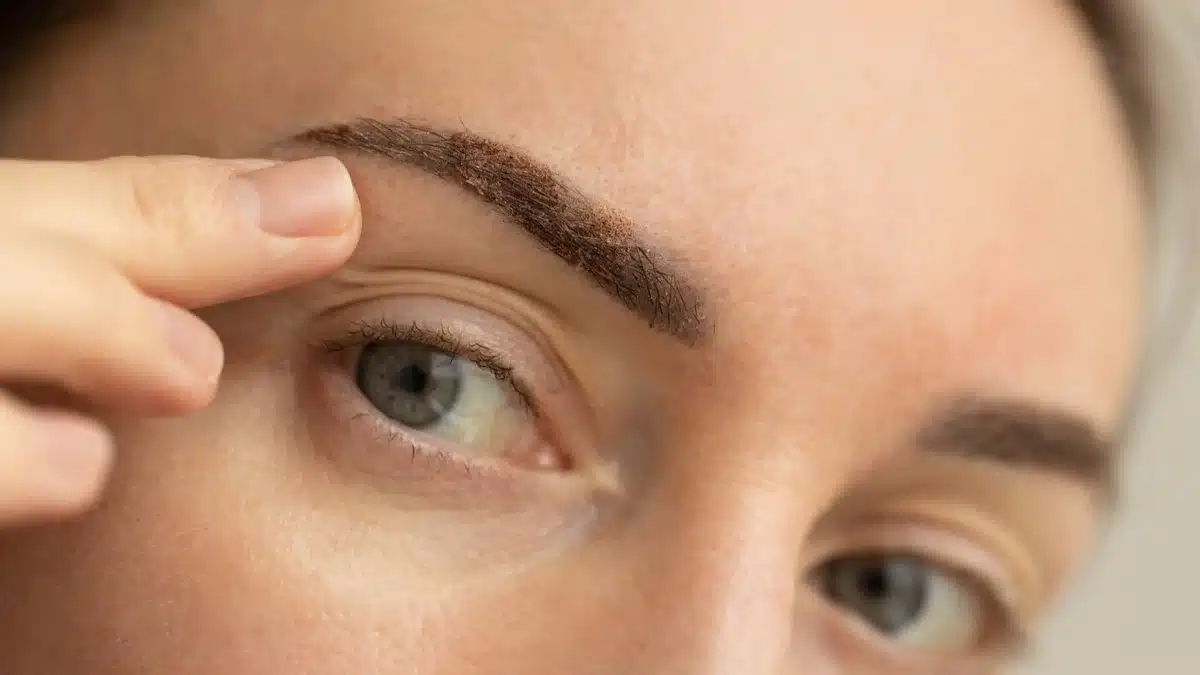
Once the undertone is neutralized, the actual concealer is applied — but not across the entire under-eye. Instead, three micro-points are deposited with precision:
- In the inner corner of the eye
- At the center of the dark circle
- Slightly toward the outer corner
These three points are then blended delicately, always upward. This upward motion is not accidental. It creates a subtle lifting effect on the contour of the eye, giving the look of a naturally rested, open gaze. The skin appears fresh rather than covered.
Always blend the micro-points upward, never downward. This direction creates a natural lifting effect and prevents product from settling into fine lines beneath the eye.
Why this technique works where others fail
The logic behind the invisible corrector method is rooted in restraint. By limiting coverage to only the areas that genuinely need it — rather than blanketing the entire under-eye — the skin retains its natural texture. Light reflects off it normally. Fine lines are not filled with pigment that will eventually crease.
Concrètement, the difference is visible within hours of wear. Traditional full-coverage application often migrates into the fine lines around the eye as the day progresses, creating a caked or creased appearance by midday. The micro-point approach, applied in light layers, stays closer to the skin and moves with it.
This is the same philosophy driving broader shifts in beauty right now. Just as women are moving away from heavy foundations in favor of second-skin formulas, the under-eye is getting the same treatment. Less coverage, more correction. The skin reads as better, not more made up.
And the lifting effect achieved through upward blending adds a dimension that traditional concealer application simply does not offer. The result is a contour that looks luminous and open — an effect that no amount of heavy coverage can replicate.
micro-points of concealer — the only coverage the invisible corrector technique requires
The right products for an undetectable finish
Not every concealer works for this technique. The goal is a lightweight, buildable formula that blends easily without grabbing onto texture. Thick, full-coverage sticks designed for maximum opacity tend to resist the feather-light application this method requires.
Color correctors worth knowing
The first step — the color-correcting phase — calls for a peach, salmon, or rosy shade depending on skin tone. Deeper skin tones generally need a more intensely pigmented orange or terracotta corrector to neutralize the darkness effectively. Lighter skin tones do well with a soft peach or pink-salmon. The corrector should be applied sparingly and blended thoroughly before any concealer goes on top.
Concealer texture and finish
For the micro-point step, a fluid or creamy concealer with a satin or natural finish performs best. Matte formulas can look flat and emphasize texture. Luminous finishes, used lightly, reflect light in a way that mimics the natural brightness of well-rested skin. This is exactly the kind of quick beauty trick that delivers a visible result without adding complexity to a routine.
The invisible corrector technique is not a complicated method. It demands precision over quantity, and a willingness to use less product than feels instinctive. But on the faces of Hailey Bieber and Dua Lipa — observed backstage and on red carpets by the makeup artists who created those looks — the results speak clearly. Corrected, luminous, and completely undetectable.